

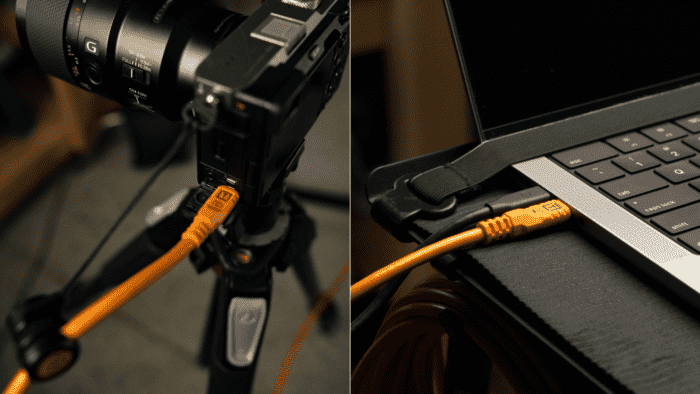
Wireless camera tethering is no longer a novelty. On the right camera, with the right software and a well-planned Wi-Fi network, it can give photographers real freedom to move while images arrive on a computer, iPad, or iPhone for review.
But “wireless” can describe several very different workflows. Some camera apps transfer selected JPEGs. Some provide remote live view and shutter control. A smaller group can send RAW files directly into professional capture software as you shoot. Those experiences are not interchangeable and none make connection speed, file size, range, or network congestion disappear.
So, can wireless tethering replace a cable? For some shoots, yes. For fast, high-volume production where every frame needs to arrive predictably, a direct USB connection is still the standard to beat.
Bottom line: Wireless can replace a cable when the camera and software explicitly support the same workflow, the capture pace is moderate, the network is controlled, and mobility matters more than the most predictable transfer time. For sustained high-volume RAW capture, an unknown location, or client-critical review, keep a direct tether as the primary path or tested fallback.
What Is Wireless Tethering in Photography?
Traditional tethered photography connects a camera to a computer or mobile device with a USB cable. Each capture travels into software such as Capture One, where the photographer, digital tech, art director, or client can review it on a larger screen. Depending on the camera and software, the team may also be able to trigger the shutter, use Live View, adjust camera settings, apply naming and metadata, or add adjustments on capture.
Wireless tethering sends those images and camera commands over Wi-Fi or a network connection instead of USB.
The important distinction is what happens after the connection is made:
| Wireless workflow | What it usually does | Best fit |
| Wireless image transfer | Copies selected or automatic images to a phone, tablet, computer, or cloud destination. | Quick sharing, backup, social delivery, and location work. |
| Wireless remote control | Adds Live View, shutter control, and some camera settings through an app. | Self-portraits, wildlife, overhead cameras, interiors, and long exposures. |
| Wireless tethered capture | Sends each new capture into professional tethering software, often with RAW support and production tools. | Client review, editing on capture, and mobile or desktop production. |
Before planning a wireless shoot, confirm which of these your exact camera, firmware, device, and software combination supports.
Also define the result before choosing the connection: Must every RAW arrive automatically? Is a JPEG preview enough? Does the operator need to change exposure from the computer? Must the camera save to its card as well? Those requirements eliminate unsuitable options faster than a headline speed claim.
How Can You Tether a Camera Wirelessly?
There are three common routes.
1. Use the Camera Manufacturer’s Wi-Fi App
Most current camera systems offer an app that uses the camera’s built-in Wi-Fi and Bluetooth features. Popular examples include:
Canon Camera Connect for image transfer, Live View, remote capture, and selected camera controls.
Nikon SnapBridge for mobile transfer and remote features, plus NX Tether for supported wired and wireless computer workflows.
Sony Creators’ App or Imaging Edge Mobile for compatible mobile workflows, and Imaging Edge Desktop for supported remote shooting over Wi-Fi or USB.
FUJIFILM XApp for wireless image transfer, remote control, and Live View on compatible cameras.
These apps can be excellent for moving a few images, controlling a remotely placed camera, or reviewing on a phone. However, an app that transfers photos is not automatically a full tethered-production environment. Check whether it can automatically receive every capture, transfer the file type you need, save to the camera card, support Live View, and fit your editing or delivery workflow.
Canon: Camera Connect and EOS Utility

Canon Camera Connect is the lightweight phone-and-tablet route. On supported cameras it can transfer images, show remote Live View, trigger the shutter, and change selected settings. It is a practical choice for quick client previews, social delivery, self-portraits, remotely positioned cameras, and small location kits. File sizes, formats, automatic transfer, and available controls vary by body; depending on the connection mode, joining the camera’s Wi-Fi can also interrupt normal internet access on the mobile device.
Canon EOS Utility is the computer-oriented first-party route. Supported cameras can use USB or a configured Wi-Fi/network path for remote shooting and image transfer. It is better suited than a phone-only app to full-resolution file management and can feed another application through a tested watched-folder or auto-import handoff. The tradeoff is a more involved network setup and less unified organization, adjustment, and client-review tooling than a direct Capture One session.
Best fit: Camera Connect for lightweight mobile review and control; EOS Utility for first-party Canon camera-to-computer operation.
Nikon: SnapBridge and NX Tether
Nikon SnapBridge is designed for mobile transfer and remote photography. Compatible cameras can offer Live View, shutter release, and selected controls. It is strongest when a fast review image is enough; RAW download and remote features are not universal, so do not assume every NEF will reach the device or that every body offers the same controls.
Nikon NX Tether is Nikon’s computer tethering application. Supported bodies can transfer captures and provide camera control over USB or approved wireless paths; some built-in Wi-Fi setups also use Wireless Transmitter Utility during configuration. Nikon recommends USB when transfer speed is the priority, and some cameras that work with NX Tether over USB do not support its wireless route.
Best fit: SnapBridge for mobile control and quick review; NX Tether for supported Nikon bodies that need first-party capture to a computer.
Sony: Creators’ App and Imaging Edge Desktop Remote

Sony Creators’ App supports image transfer and remote shooting on compatible Sony cameras and mobile devices. It keeps the location kit compact and works well for sharing, small crews, and remotely positioned cameras. RAW/JPEG behavior, background transfer, and control depth vary by camera and mobile platform, while phone power management can affect longer sessions.
Imaging Edge Desktop Remote provides computer-based remote shooting over Wi-Fi or USB on supported Sony models. Depending on the camera, it can add Live View, focus and exposure controls, and transfer RAW or JPEG files for computer review. It is the more production-oriented first-party option, although teams whose final workflow lives in another application should test that downstream handoff.
Best fit: Creators’ App for current Sony mobile workflows; Imaging Edge Desktop Remote for first-party computer control and file delivery.
Fujifilm: XApp, FUJIFILM Tether App, and Lightroom plugins
FUJIFILM XApp supports wireless transfer, remote control, Live View, automatic transfer orders, and camera-settings backup and restore on compatible bodies. It is designed primarily for phones and tablets. Original-size or compressed transfers may be available on supported combinations, but large originals still take time and battery power.
For computer workflows, the FUJIFILM Tether App and Adobe Photoshop Lightroom tether-shooting plugins provide first-party paths on compatible cameras. Supported Wi-Fi-capable models can tether without relying on a generic watched-folder bridge, but plugin tier, camera firmware, operating system, Lightroom version, Live View, and available controls must all match.
Best fit: XApp for mobile sharing and control; the Tether App or appropriate Lightroom plugin for supported Fujifilm desktop workflows.
2. Use Capture One Wireless Tethering
Capture One supports wireless tethering for selected cameras, with additional supported systems listed in its current compatibility database. Support is model-specific. A camera that works over USB may not work wirelessly, and available controls can vary by manufacturer, firmware, and software version.

Capture One mobile brings supported tethered workflows to iPad and iPhone. Depending on the camera, photographers can receive captures, use Live View, control supported settings, and choose whether files are saved to the mobile device, the camera card, or both. Transferring JPEGs instead of full RAW files may make sense when fast review matters more than immediate access to the full-resolution original.
Capture One’s second-generation Canon wireless workflow goes further on a small number of supported cameras. At the time of publication, the Canon EOS R5 Mark II and EOS R1 can send a smaller, editable RAW file first while the full-resolution RAW transfers in the background. This makes the image available for review and adjustment sooner. The full file still has to complete its transfer, and Capture One requires version 16.8 or later for this feature.
That is a meaningful step forward, but it is not universal. Always check the live Capture One camera compatibility list before committing a production to wireless.
Why it stands out
- It is the closest wireless equivalent to a conventional professional capture session when the camera is supported.
- RAW/JPEG handling, organization, adjustments, and client review stay in one production application.
- Desktop and mobile options support studio, location, and compact iPad/iPhone workflows.
- Save-to-memory-card behavior is available on supported camera and workflow combinations.
Watch-outs
- Wireless camera support is narrower than general USB support and remains model- and firmware-specific.
- Large RAW files can queue when the photographer’s cadence exceeds practical wireless throughput.
- For optimal Canon stability, Capture One recommends a dedicated access point with the computer connected by Ethernet or USB, leaving only the camera-to-network leg wireless.
- Camera firmware, operating-system, and Capture One updates should be checked together before each production.
Best fit: photographers and digital techs already using Capture One who want the most complete wireless capture, review, and adjustment environment available for a supported camera.
3. Use a Dedicated Wireless Transmitter, Router, or Bridge
Some cameras support an optional wireless transmitter, while third-party wireless tethering devices can bridge a camera to a computer or mobile device. A dedicated access point or travel router can also create a controlled network on location.
This can improve range, network control, and stability compared with an improvised connection. It also means carrying, powering, configuring, and troubleshooting more equipment. Capture One’s Canon guidance, for example, recommends a dedicated access point connected to the computer by Ethernet or USB for the best performance and stability. A camera-to-laptop Wi-Fi link or phone hotspot may be simpler, but performance can be less predictable.
CamRanger 2
CamRanger 2 is dedicated hardware that connects to a supported camera with a short USB cable, then creates its own Wi-Fi network for an iOS, Android, macOS, or Windows device. On supported combinations it can provide camera control, Live View, image transfer, focus stacking, HDR, time lapse, and multi-device viewing. The photographer works untethered from the computer, but the camera is still physically connected to the CamRanger unit.
Strengths: no venue Wi-Fi or internet connection is required; the remote-control toolset is broad; multiple devices can share the view; and dedicated hardware creates a more controlled network than an improvised phone hotspot.
Tradeoffs: the kit adds cost, battery management, mounting, a short camera cable, and another device to configure. Functions vary by camera and platform, and CamRanger remains its own capture ecosystem rather than a direct replacement for every Capture One or Lightroom workflow.
Best fit: remote cameras, longer working distances, advanced capture tools, and multi-device review when the supported-camera matrix matches the job.
Other Software and Bridge Workflows
Cascable Studio
Cascable Studio is an Apple-focused third-party application for compatible Canon, Fujifilm, Nikon, OM System/Olympus, Panasonic, Sony, and Phase One cameras. Depending on the camera and Apple device, it can provide remote control, Live View, transfer, automation, and selected tethering features. Its multi-brand approach is useful for photographers who work across systems, while long-exposure, time-lapse, bracketing, and remote-camera tools can be especially valuable on location. It is not a universal Windows or Android solution, and exact feature support must be checked by camera.
Best fit: Apple-centered photographers using multiple supported brands or needing flexible remote-control and automation tools.
Lightroom Classic

Lightroom Classic should not be described as a universal native Wi-Fi tethering solution. A Lightroom-centered wireless workflow generally uses one of three routes: a supported manufacturer plugin, such as Fujifilm’s documented path; manufacturer or third-party software that delivers files to a watched folder for Lightroom auto import; or capture in another application followed by a controlled transfer or synchronization into Lightroom.
A watched folder can make images appear automatically, but it may not provide direct camera control, immediate queue visibility, or the failure reporting of true tethered capture. Test the camera-to-utility transfer and the utility-to-Lightroom handoff as one workflow.
Smart Shooter
Smart Shooter is a capable tethered-capture option for supported cameras, but it should not be assumed to provide a universal native Wi-Fi path. Older Tether Tools material may pair Smart Shooter with legacy Air Direct hardware. For a new production, confirm the current camera, software, and connection combination in the Tethering Software Finder, and plan a direct wired workflow unless current documentation explicitly supports the intended wireless route.
Quick Answer: Which Option Fits the Shoot?
| Shoot requirement | Start with | Why |
| RAW files in a professional capture session | Capture One on a supported camera | Closest current alternative to a conventional production tether, with model-specific control and file handling. |
| Phone/tablet control or selected images | The camera maker’s mobile app | Usually the simplest route with no bridge hardware. |
| First-party camera-to-computer control | EOS Utility, NX Tether, Imaging Edge Desktop, or FUJIFILM Tether App | Brand-specific desktop tools may provide deeper control than mobile apps. |
| Apple-focused, multi-brand workflow | Cascable Studio | Useful for supported mobile/Mac workflows, remote tools, and automation. |
| Long-range control or multiple viewers | CamRanger 2 | Creates its own network and adds advanced remote functions on supported cameras. |
| Images appearing in Lightroom Classic | Supported Fujifilm plugin or a tested watched-folder bridge | Lightroom’s standard tethering is not a universal direct Wi-Fi connection. |
| Sustained high-volume RAW capture | Direct tethering cable | A dedicated physical path is easier to predict and troubleshoot. |
No row replaces a model-level compatibility check. Verify the camera, firmware, operating system, application version, file type, controls, save destination, and recovery behavior together.
What Do You Need for Reliable Wireless Camera Tethering?
- A professional wireless setup usually depends on the whole connection chain:
- A camera model that supports the required wireless function.
- Current camera firmware.
- A supported version of the desktop or mobile tethering software.
- Correct network, PC Remote, or tether-shooting settings in the camera.
- A strong Wi-Fi connection, ideally on a dedicated network.
- A clear plan for RAW versus JPEG transfer and save-to-card behavior.
- Enough camera, router, computer, and mobile-device power for the session.
- A tested wired fallback.
Test the exact production setup before shoot day. “It connected once” is not the same as “it sustained the expected capture rate with the final file settings.” Shoot a realistic burst, watch the transfer queue, move through the intended working area, and confirm that every file reaches the correct destination.
Why Wireless Tethering Performance Varies
Wi-Fi Is a Shared Environment
A USB cable creates a dedicated physical data path. Wi-Fi uses radio spectrum shared with phones, laptops, tablets, access points, video devices, and neighboring networks. A setup that is fast in an empty studio may behave differently in a hotel, office, event venue, or crowded commercial set.
Distance and Obstacles Affect the Signal
Walls, people, metal equipment, carts, and the position of the camera and access point can all influence a wireless connection. Moving farther away may reduce throughput or increase transfer time. The freedom to roam is real, but the edge of usable range is not always obvious until files begin to queue.
Large RAW Files Still Have to Move
High-resolution cameras produce large files. Wi-Fi does not reduce the amount of data unless the workflow deliberately sends a smaller RAW or JPEG first. For high-volume fashion, product, portrait, and e-commerce capture, the practical question is not merely whether a file can transfer wirelessly. It is whether the system can keep up with the photographer’s real capture cadence without creating a backlog.
Wireless Uses Camera Power
Maintaining Wi-Fi, negotiating a network connection, transferring files, and providing Live View all consume power. The effect varies by camera and workflow, but extra batteries or continuous-power planning should be part of the setup.
There Are More Variables to Troubleshoot
Wireless problems can come from the camera, firmware, software, computer, mobile device, router, network credentials, channel congestion, security settings, range, or power. On a small shoot, that may be manageable. On a production where talent and crew are waiting for images, every extra variable has a cost.
How to Test Wireless Tethering Before a Shoot
- Use the actual camera, firmware, file settings, device, operating system, application version, router, and batteries planned for the job.
- Confirm the complete compatibility chain. Check the exact model, firmware, operating system, application version, wireless mode, file type, remote controls, and save destination.
- Choose the production file strategy. Decide whether the review device needs full RAW, smaller RAW, JPEG, or RAW+JPEG, and confirm whether originals also save to the camera card.
- Reproduce the location. Test the expected distance, obstacles, people, carts, metal equipment, and access-point position.
- Shoot at the real cadence for at least ten minutes. Use the production image size and realistic bursts; watch whether the queue grows or returns to zero.
- Record typical and worst transfer times, missed or duplicate files, connection drops, queue recovery, battery use, usable range, and whether naming and adjustments apply correctly.
- Interrupt the connection deliberately. Step out of range or restart one device, then confirm that reconnection and queued-file recovery work without gaps.
- Time the wired fallback. Switch paths and confirm that a new frame reaches the intended session or folder.
- Set a failure threshold before the job. For example, switch to wired after a defined queue depth, two missing files, two connection drops, or any delay that starts controlling the set’s pace.
How to Build a More Reliable Wireless Network
- Use a dedicated network or access point instead of a crowded production or venue network.
- Use the least-congested band supported by the camera and access point. A 5 GHz network often offers more capacity at practical set distances, but may have less reach through obstacles than 2.4 GHz.
- When supported, connect the computer to the access point by Ethernet or USB so only the camera-to-network leg is wireless.
- Elevate the access point and keep it away from metal carts, large displays, power distribution, and obvious radio-frequency congestion.
- Keep the camera, router, computer, and mobile devices powered; Live View and transfer can accelerate battery drain.
- Disable automatic network switching, aggressive sleep, and unrelated synchronization traffic if they interfere with the tested workflow.
- Avoid an untested phone hotspot as the production network.
- Troubleshoot in a fixed order: camera mode, network connection, computer address, application state, queue, and file destination.
- Protect the network with a password, avoid public Wi-Fi, and treat remote review as a separate distribution layer from primary capture.
Wireless vs. Wired Tethering: Which Is Better?
Neither connection is best for every job. The useful question is which risk matters more on this shoot: restricted movement or unpredictable transfer performance?
| Choose wireless tethering when… | Choose wired tethering when… |
| The photographer needs maximum mobility. | Every capture must appear as consistently as possible. |
| The camera and software explicitly support the workflow. | The camera has wired support but limited or no wireless support. |
| The capture rate is moderate. | The shoot produces a high volume of large RAW files. |
| A phone or tablet is the preferred review device. | A digital tech, client, or creative team is reviewing in real time. |
| The wireless environment is controlled and tested. | The location’s Wi-Fi environment is unknown or congested. |
| A short delay or queued transfer will not stop production. | Downtime or delayed review is expensive. |
Many photographers will use both. Wireless can be the primary connection for a low-volume location portrait or a camera placed where a cable would be impractical. Wired can be the primary path on a catalog day, with wireless or save-to-card serving as an alternate workflow.
Why a Purpose-Built Tethering Cable Still Matters

Choosing a cable does not automatically guarantee a reliable connection. USB-C describes a connector shape, not one fixed level of data performance. Cable length, signal integrity, supported protocol, camera and computer ports, and the cable’s internal design all affect the result.
The TetherPro Optima 10G USB-C cable is engineered as a data-first connection for professional tethered capture. It supports USB-C 3.2 Gen 2 data rates up to 10Gbps, uses integrated TetherBoost technology to maintain signal performance over longer runs, and does not support USB Power Delivery so the cable can prioritize image data instead of device charging.
The actual transfer speed is always limited by the slowest part of the system including the camera port, computer port, software, and storage but a dedicated 10Gbps-rated path removes the changing wireless environment from the connection.

Optima 10G base cables are available in working lengths from 20 inches to 31 feet. Compatible TetherBoost extensions can build a tethered run up to 63 feet while maintaining a 10Gbps-rated connection. Add proper strain relief, such as a TetherGuard LeverLock Plus Tripod Plate, to help protect the camera port and reduce accidental disconnects.
That means “wired” does not have to mean working within arm’s reach of a laptop. A long, secured tethering system can preserve significant movement while keeping a direct data path.
A Practical Hybrid Tethering Workflow
- For productions that want mobility without giving up a dependable fallback, plan both paths:
- Confirm wireless support for the exact camera, firmware, software, and destination device.
- Save originals to the camera card whenever the supported workflow allows it.
- Use a dedicated 5 GHz network or access point when the camera and environment support it.
- Decide whether the review device needs RAW files or whether JPEGs will move faster and still meet the job.
- Keep the router or access point elevated and away from obvious sources of interference.
- Carry the correct tethering cable and port protection, even when wireless is the planned primary connection.
- If transfers begin to queue or the network becomes unstable, move to the wired path before production stalls.
- The best backup is not an untested piece of gear in a case. It is a second workflow the team already knows how to activate.
Expanded hybrid checklist
Before the shoot
- Verify RAW/JPEG behavior, automatic transfer, remote controls, and save-to-card settings.
- Test realistic cadence, working distance, obstacles, queue recovery, and battery drain.
- Define when delayed transfers or drops will trigger the wired fallback.
- Confirm both paths write to the intended session or folder without overwriting files.
During the shoot
- Watch the transfer queue, not only the latest preview, and reconcile file counts at planned checkpoints.
- Keep camera and network power visible; replace batteries before they become urgent.
- Treat slow previews, repeated reconnects, or a growing queue as early warnings.
- Switch to the tested cable before delayed review begins controlling production pace.
Before wrap
- Confirm every expected file exists at the required destination.
- Verify all background full-resolution transfers have completed.
- Reconcile camera-card and computer file counts if both were used.
- Complete the production backup and handoff before dismantling the workstation.
Is Wireless Tethering Ready to Replace a Cable?
Wireless tethering is ready for real professional use—when the camera is supported, the network is controlled, and mobility is more important than the most predictable transfer path.
It is not yet a universal replacement for a cable. Compatibility remains uneven, wireless conditions change from set to set, and high-volume RAW capture can expose the limits of a network quickly. Even the most advanced wireless workflows still require careful setup, power planning, and a strategy for interrupted or delayed transfers.
When freedom of movement is the priority, use wireless with confidence after testing it. When fast, consistent image delivery is critical to the crew, client, and schedule, a purpose-built tethering cable remains the simplest way to remove an entire category of variables.
Build the connection around the shoot—not the trend. For a direct, data-first workflow, explore TetherPro Optima 10G.
Wireless Tethering FAQ
Can I tether my camera to a computer wirelessly?
Yes, if the camera and software support wireless tethered capture. Compatibility is specific to the camera model, firmware, operating system, and software version. Built-in Wi-Fi alone does not guarantee that a camera can send every capture into desktop tethering software.
Can Capture One tether wirelessly?
Yes. Capture One supports wireless tethering on selected Canon, Nikon, Sony, Fujifilm, and other camera models on desktop and mobile. Features vary by camera. Check Capture One’s current compatibility list before a shoot.
USB support does not guarantee wireless support, and model-specific control, file format, save-to-card behavior, and recovery should all be verified.
Can Canon, Nikon, Sony, and Fujifilm cameras tether wirelessly?
Selected models can. Each brand provides mobile transfer or remote-control software, and each offers one or more computer-oriented routes. The result may be simple image transfer, remote shooting, or true tethered capture depending on the exact model and application.
Can Lightroom Classic tether wirelessly?
Not as a universal native workflow. Supported Fujifilm plugins provide one documented path. Other cameras may use manufacturer or third-party software to deliver files to a watched folder for Lightroom auto import, but that bridge is not the same as direct camera control and should be tested end to end.
Can I wirelessly tether to an iPad or iPhone?
Yes. Capture One mobile and manufacturer apps support various iPad and iPhone workflows. Some provide full tethered capture; others focus on remote control or image transfer. Confirm file types, save destinations, camera controls, and model support before choosing the app.
Cascable Studio and CamRanger 2 add further supported iPhone and iPad options when multi-brand control, automation, dedicated hardware, or multiple viewing devices are useful.
Is wireless tethering as fast as USB-C?
It can feel fast with supported cameras, smaller RAW files, JPEG-first workflows, and a strong dedicated network. But performance depends on signal strength, network traffic, file size, hardware, and distance. A direct cable provides a more predictable data path for sustained, high-volume transfer.
Does wireless tethering save RAW files?
Some systems transfer full RAW files, some can send a smaller RAW first, and others transfer JPEGs or selected images. Save-to-card options also vary. Verify the file-format and destination controls for the exact camera and software combination.
What is the best wireless tethering software?
For true professional tethered capture, Capture One is the strongest starting point when the camera is supported. Manufacturer apps are often best for simple mobile transfer or remote shooting. Cascable Studio suits Apple-centered multi-brand workflows, while CamRanger 2 is compelling when dedicated hardware, advanced control, or multiple viewing devices justify the added kit. The best choice is the one that supports the required file, control, destination, and recovery behavior on the exact camera.
Should I carry a tethering cable if I plan to shoot wirelessly?
Yes. A tested cable is the fastest fallback when a location’s network is crowded, a transfer queue grows, batteries run low, or a software update changes wireless behavior.
Carry the correct camera-to-computer cable, any required extension or adapter, and camera-side strain relief—and confirm the crew can switch paths under pressure.
