


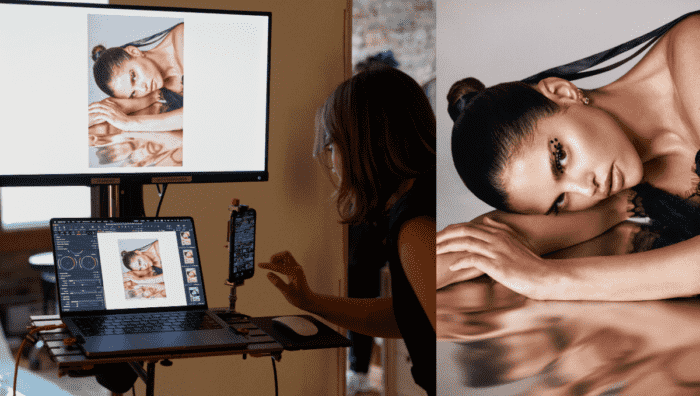
For Bodies as Architecture, Montreal fashion photographer Dariane Sanche combined controlled shade, one diffused silver umbrella, a mirrored façade, and sculptural posing. The result is a practical outdoor fashion photography lighting setup that moves from monumental full-length frames to intimate reflective beauty portraits without losing visual cohesion.
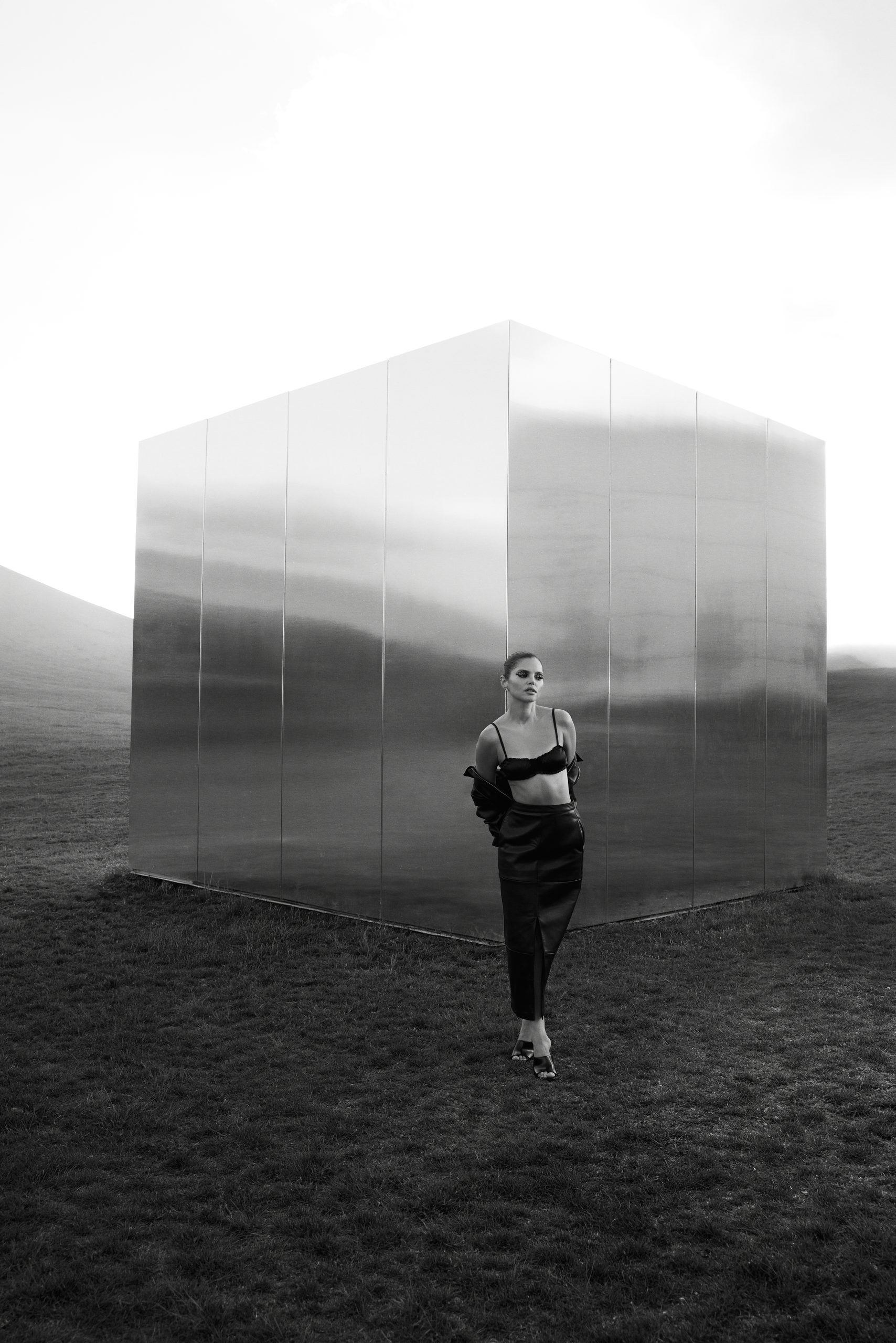
The first thing you notice is scale. A figure in black stands before a silver structure that seems to rise out of the landscape without windows, doors, or any obvious sense of size. Its vertical seams pull the eye upward. Its surface carries blurred bands of sky and earth. The model feels both small against it and completely in command of it.
Then Dariane Sanche moves closer.
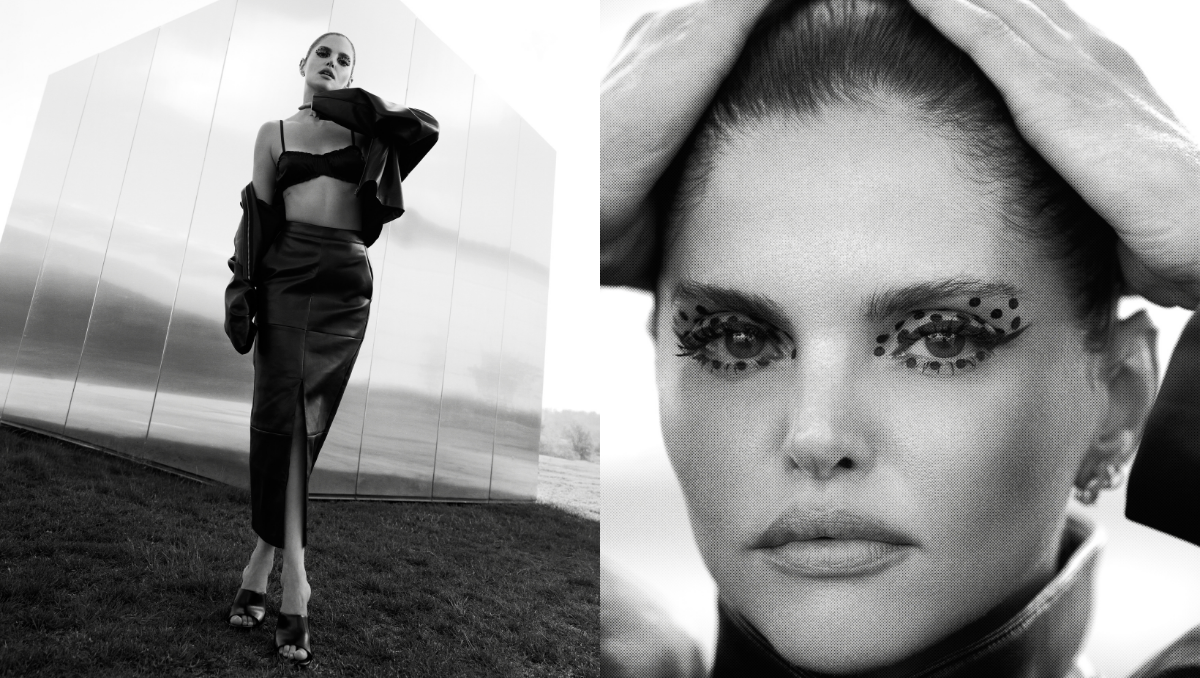
The building becomes a plane of light. The body becomes a series of angles: shoulder, wrist, waist, jaw. In the beauty portraits, a face lies against a reflective surface and nearly doubles. A ribbon stretches from the model’s hair like a drawn line. Graphic dots around the eyes echo the project’s repeating geometry. Across wide portraits, tight crops, reflections, and fragments, the series develops its visual premise: Bodies as Architecture—lines, reflections, fragments. A study in contrast.
For Sanche, known professionally as DS Sanchez, the shoot was bigger than a lighting test or a gear demonstration. Her lighting setups were part of a broader exercise in making body and structure speak the same visual language.
The series unfolds in two distinct settings. Inside, the focus is reflection and contrast. Mirrored surfaces multiply and fragment the body until subject, reflection, and space begin to blur. Light and shadow become structural elements, revealing some forms while allowing others to disappear. Outside, the exploration shifts toward geometry, scale, and perception. Against a monumental stainless-steel cube, the model becomes an organic counterpoint to rigid architecture. Changing angles continuously reshape both the body and the structure.
Across both settings, Sanche approaches the body almost as architecture itself: a composition of lines, curves, intersections, and negative space. Its movement, softness, and imperfection stand against the precision of the built environment. Bodies as Architecture is ultimately a study in contrast—organic and constructed, softness and rigidity, reality and reflection, the whole and the fragment.
Start with an outdoor fashion photography location that already contains the idea
The reflective building was not treated as a neutral backdrop. It supplied the visual rules for the shoot.
Its polished skin created soft horizontal reflections, while its panel seams formed crisp vertical lines. The structure could read as a minimal silver cube in a wide frame or dissolve into an abstract metallic field when Sanche moved closer. That gave her multiple backgrounds without changing locations.
The exterior also established the palette. Black leather and lingerie created clean separation against the silver surface and bright sky. Grass anchored the scene with texture, but the final black-and-white treatment reduced the environment to tone and shape. The location’s lack of obvious scale made the model appear to occupy a space somewhere between landscape, sculpture, and set design.
Sanche reinforced that effect through camera position. In the full-length frames, a low angle elongates the body and lets the building rise behind the model. In the widest composition, she pulls back far enough to let negative space dominate. The subject is no longer simply posing in front of architecture; her silhouette becomes another structural element within it.
What photographers can take from the location choice
- Look for a location that offers more than a surface. Repeating lines, reflective materials, corners, and changes in scale can generate an entire shot list.
- Decide what the location contributes to the concept before adding light. Here, silver reflection, vertical seams, and open sky established the project’s geometry.
- Work the same background from multiple distances. An establishing frame, a full-length portrait, and a tight crop can feel like different sets when the architecture is strong.
Direct the pose as a graphic shape
The posing follows the same logic as the building. Arms bend into diagonals. Hands frame the head or cross the torso. A jacket slips from one shoulder and creates an asymmetrical black mass. In the low-angle full-length portrait, one arm lifts the collar toward the face while the other drops, interrupting the otherwise long vertical silhouette.
These gestures do more than show the clothes. They control the negative space around the body.


Sanche also uses the wardrobe to extend the pose. The structured leather catches narrow highlights and holds a defined edge against the reflective background. A long skirt emphasizes the vertical line of the body, while the cropped jacket and exposed midriff divide that line into distinct sections. The result feels architectural because the pose, styling, and frame are all working in the same direction.
In the closer portraits, the gestures become quieter but no less precise. A hand closes around the collar. Both hands meet above the head. The model rests her cheek on her forearm. Each pose creates a boundary that leads the viewer back toward the eyes.
Build contrast into every layer
“A study in contrast” describes more than the decision to publish many of the images in black and white. Contrast runs through the entire production:
- A soft, enveloping source against a hard metallic location.
- Bare skin beside structured black leather.
- A monumental exterior portrait followed by an intimate beauty crop.
- Smooth reflections interrupted by seams, hands, lashes, and graphic eye makeup.
- Clean tonal photographs paired with grainy or halftone-style treatments.
The makeup becomes especially important in the close frames. The dots around the eyes introduce a deliberate pattern that can survive both a clean beauty treatment and a more graphic edit. They echo the building’s repeating panels without literally copying them.
That repetition gives the series cohesion. The wide outdoor frames and close beauty portraits do not rely on the same background or scale, yet they still belong together because they share a language of line, repetition, reflection, and black against pale space.
Use reflection to create a second composition
Some of the strongest beauty images are built around a reflective plane placed directly beneath the model. Sanche brings the face, hands, and forearms close to the surface, creating a second image that is recognizable but not perfectly symmetrical.

In the color portrait, the reflection opens the bottom of the frame and repeats the model’s hands, lips, and cheek. A black ribbon extends from the hair toward the corner, balancing the long line of the neck. The pose is quiet, but the composition is active: eye to eye, hand to hand, face to reflection.
In the tighter black-and-white crop, the reflection becomes more fragmented. Only parts of the face remain visible above the dividing edge. Rotating the composition removes the usual sense of upright portraiture and makes the features feel almost topographic.
A practical way to work with reflections
Reflection-heavy images benefit from small, deliberate adjustments. A few centimeters can determine whether the doubled face feels elegant or confusing. Watch the line where the subject meets the reflective surface, then adjust the camera height, chin position, and hand placement independently. The goal is not always symmetry; it is a second layer that supports the original composition.
A larger review image also helps here. Reflections can introduce doubled eyelashes, awkward overlaps, bright edges, or distracting gaps that are easy to miss on the back of a camera.
How Sanche lit the indoor portraits
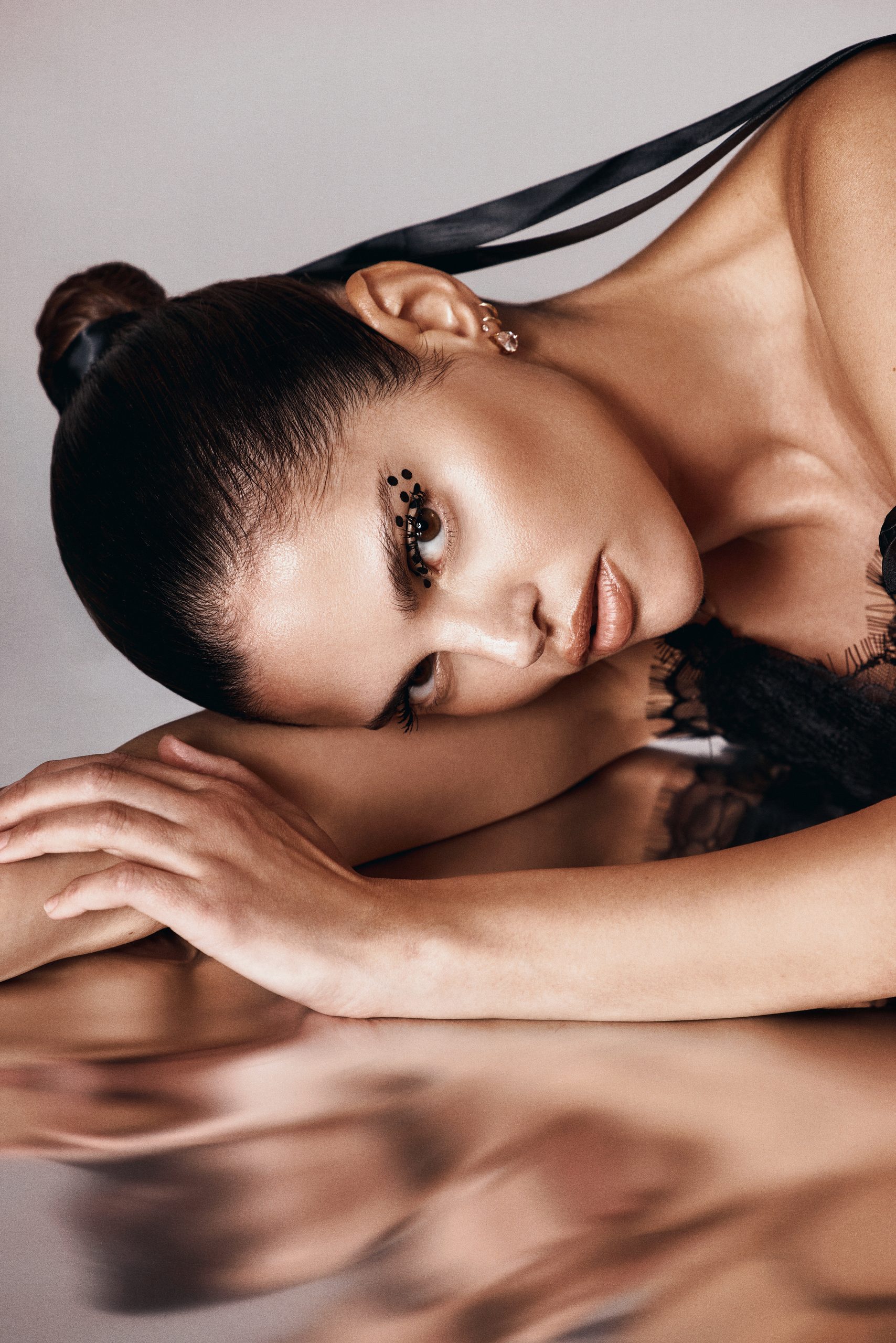
The interior photographs required a different lighting architecture from the single-light exterior. Sanche used a Broncolor Scoro 3200 power pack with three Broncolor Pulso G heads to build soft illumination from above while retaining shape on the model’s face.
- On camera left, a top light fired into a Broncolor 105 cm transparent umbrella aimed toward the ceiling.
- Also on camera left, a lower side light fired into a Broncolor 110 cm umbrella with diffusion and was directed toward the model’s face.
- On camera right, a second top light fired into another Broncolor 105 cm transparent umbrella aimed toward the ceiling.
The two elevated sources created broad ambient lift, while the lower diffused source supplied direction and facial detail. That balance let Sanche preserve luminous skin and readable makeup without flattening the shadows, reflections, and fragments that give the indoor frames their structure.
The outdoor fashion photography lighting setup
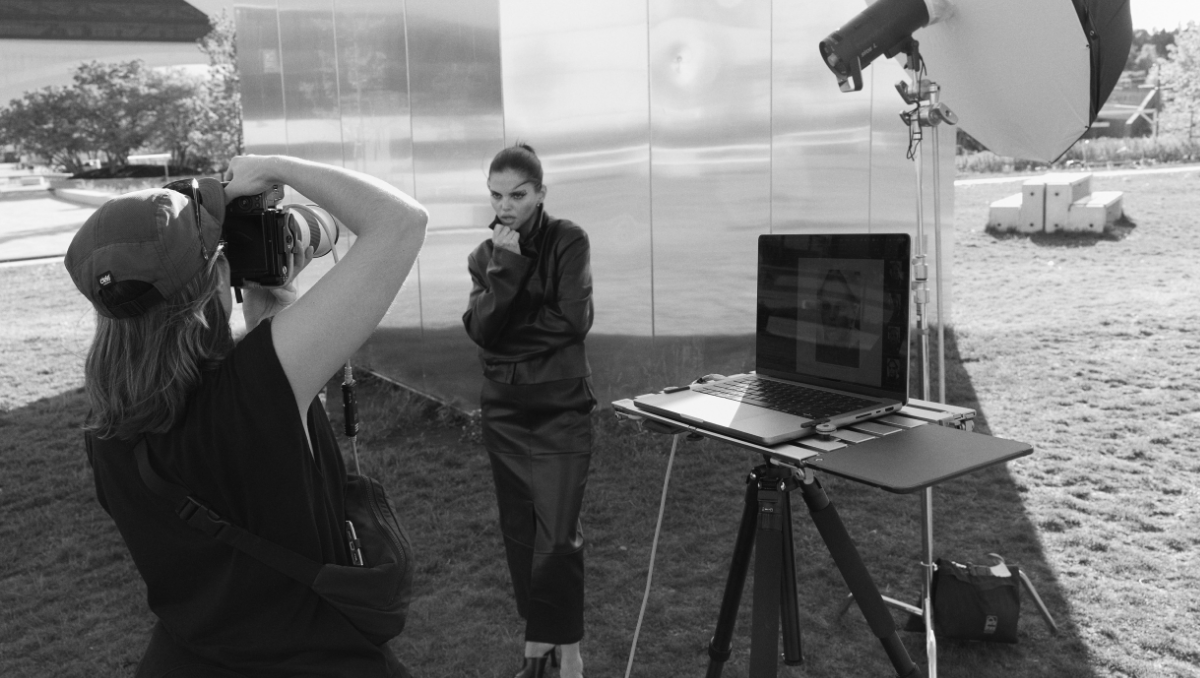
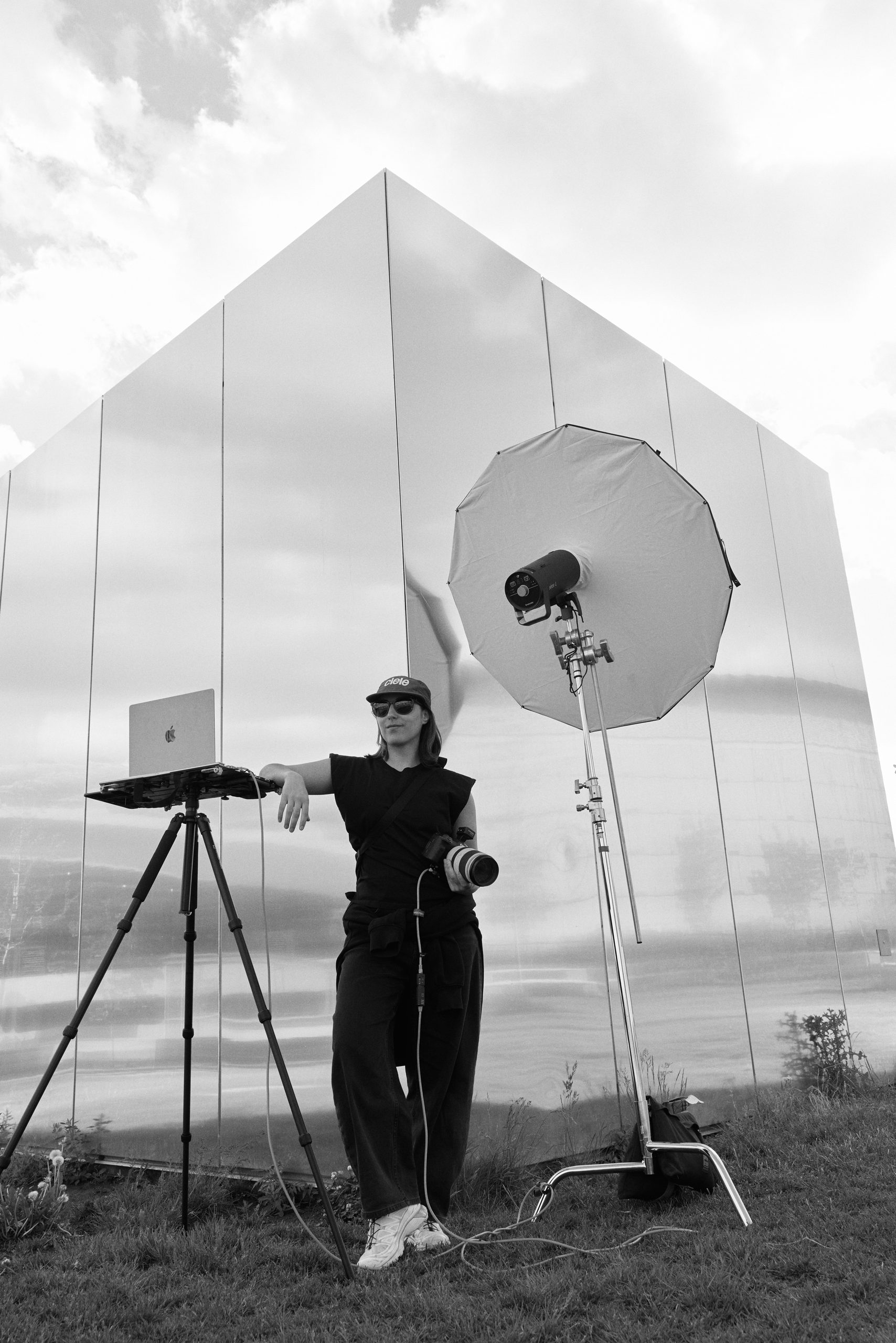
For the outdoor sequence, Sanche paired one Broncolor Siros 800 L with a 110 cm silver umbrella and diffuser. She chose to test the new diffuser on location rather than in the controlled conditions of her studio.
The first decision was not where to place the flash, but where to place the model. Sanche worked on the shaded side of the stainless-steel structure, using the building to remove direct sun from the subject. That reduced the number of variables she had to fight and let the artificial source shape the portrait more deliberately.
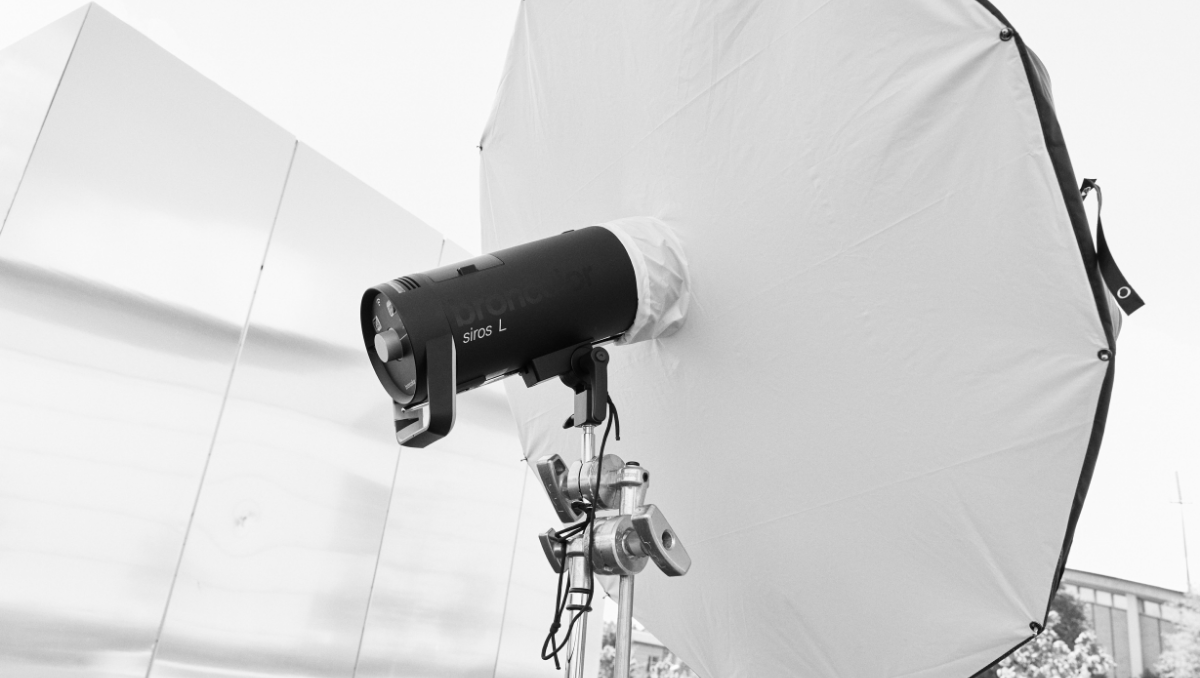
She positioned the light on camera right, between a side light and a back light, with the diffused umbrella directed toward the model’s face. From there, it could build volume in the hair, define the face, and separate the model from the reflective background. The one-light fashion photography setup stayed mobile enough for the team to work both full-length and close without rebuilding a complicated lighting plot.
The modifier gave her two useful qualities at once. A silver umbrella is efficient and directional, which helps when working outdoors. On its own, the Focus 110 produced a punchier, higher-contrast result. Adding diffusion softened the transitions and created a broader, more enveloping light across the face and body—closer to a large natural source or an overcast sky. The source could reveal skin, makeup, and black leather without erasing the crisp geometry that gave the concept its force.
“Without the diffuser, the silver umbrella produces punchy, directional, and high-contrast light. With the diffuser, the light becomes much softer, more enveloping, and natural, while maintaining excellent efficiency.”— Dariane Sanche
The finished photographs show that balance. Highlights define the leather rather than blowing it into featureless shine. Skin retains shape without appearing disconnected from the environment. The light feels controlled, but the pictures still belong outdoors.
Lighting setup at a glance
- Light: One Broncolor Siros 800 L
- Modifier: Broncolor Focus 110 silver umbrella with diffuser
- Subject position: In the shade created by the reflective structure
- Light position: Camera right, between side light and back light, directed toward the model’s face for contour, volume, and separation
- Creative goal: Soften skin and transitions while retaining enough direction to define black leather and the model’s silhouette
Camera, lenses, and exposure settings
Sanche photographed Bodies as Architecture with a Canon EOS R5 Mark II, using a Canon RF 28–70mm F2 L USM and a Canon RF 70–200mm lens. The two zoom ranges gave her room to move from monumental environmental compositions to compressed portraits and close beauty details without breaking the visual rhythm of the set.
She worked at f/5.6 and 1/160 second indoors, then moved to f/5.6 and 1/250 second outdoors. Holding the aperture at f/5.6 helped maintain consistent depth and detail across the model, clothing, and architectural elements, while the faster outdoor shutter helped manage the brighter ambient environment. ISO and flash power were not provided, so those values should be set to suit the available light, desired background tone, and flash-to-ambient balance on a comparable shoot.
Shoot a sequence, not just a single hero
The project gains energy from the way the images change scale and treatment. Sanche moves through several distinct modes:
- An environmental frame that establishes the silver structure as a monumental object.
- Low-angle full-length portraits that merge the model’s silhouette with the building’s vertical lines.
- Tight fashion portraits in which hands, collar, makeup, and expression become the geometry.
- Beauty images built around a reflective surface.
- Black-and-white, color, grain, and halftone treatments that push selected frames toward a more editorial finish.
That variety gives an editor options while preserving a unified visual identity. The lesson for fashion and portrait photographers is to plan the connective tissue before the shoot: a repeated shape, palette, material, gesture, or lighting idea that can hold different frames together.
Review the details while they can still be changed
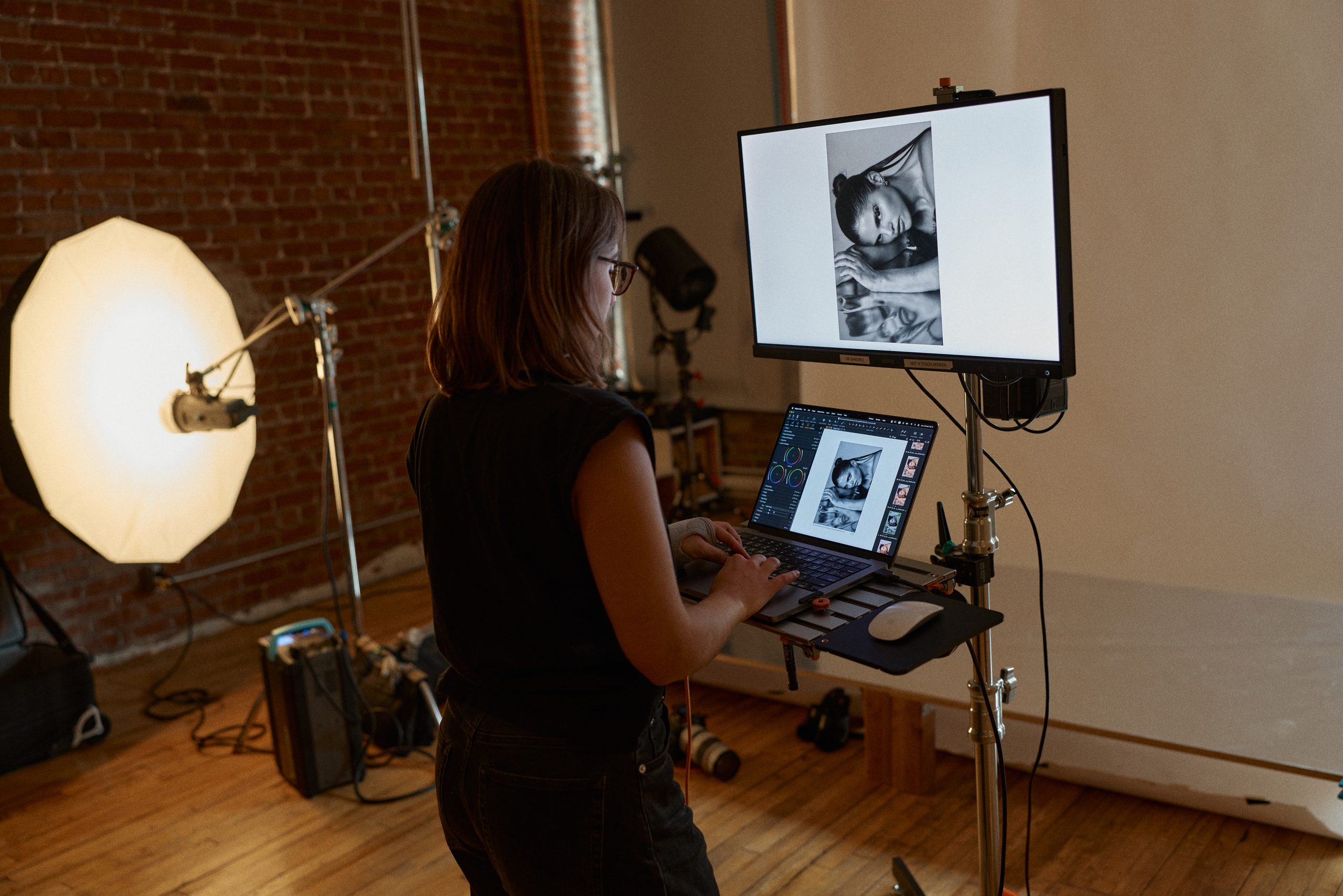
Only after the visual decisions were in place did the technology become relevant. Sanche used the AeroTrac Workstation System Ultimate Tethering Kit and additional AeroTrac accessories as a flexible review station.
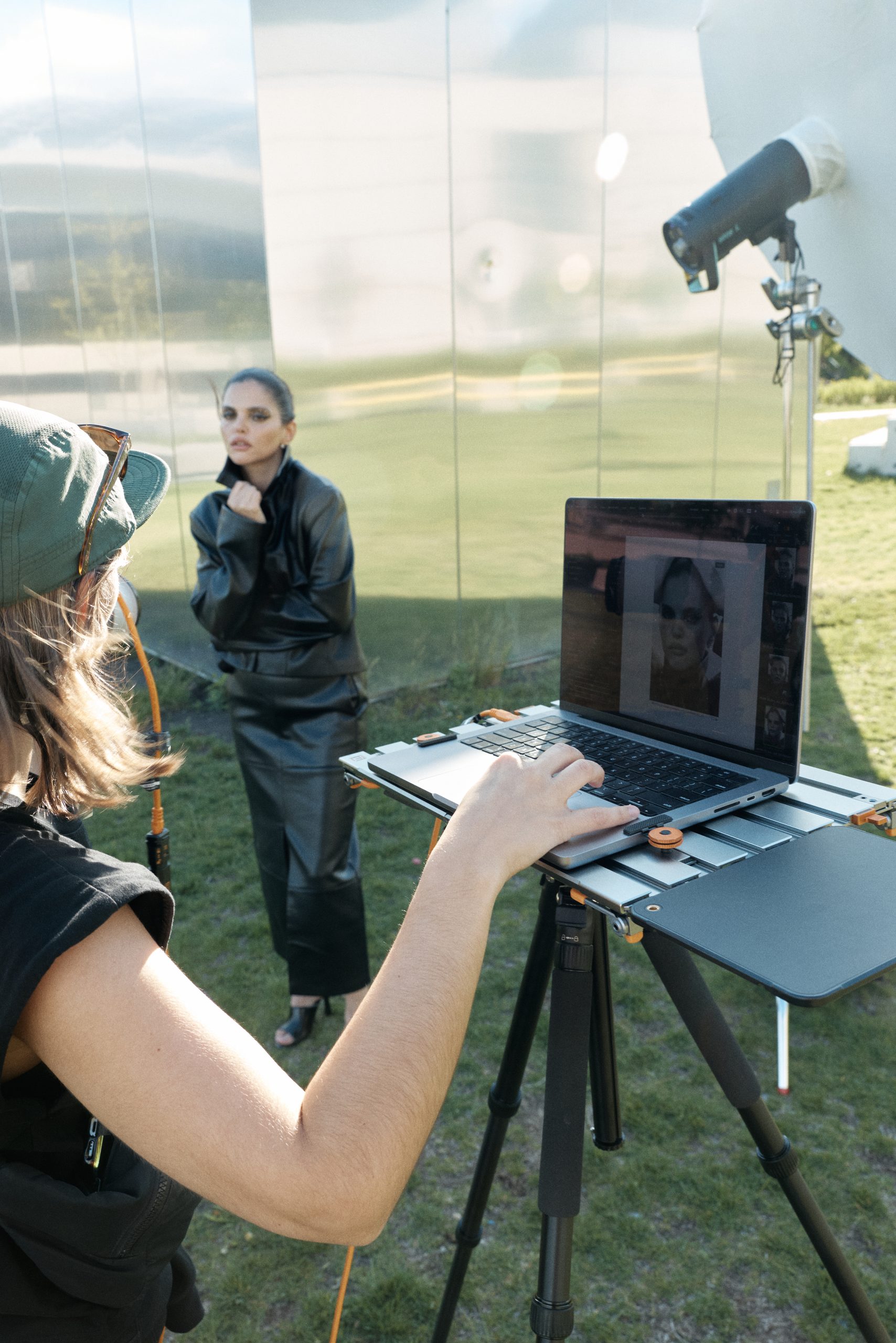
Indoors, the modular setup held a laptop, external display, mounted phone, and tethering essentials in one working area. On location, Sanche reduced it to a lean laptop platform on a tripod. That smaller configuration kept the station close enough to check focus, reflections, highlight detail, garment edges, and pose without turning the set into a fixed workstation.
For teams new to tethered photography, that is the real advantage of camera tethering on a fashion set: the photographer, digital technician, stylist, and client can evaluate the same frame while focus, light, pose, and wardrobe can still be corrected.
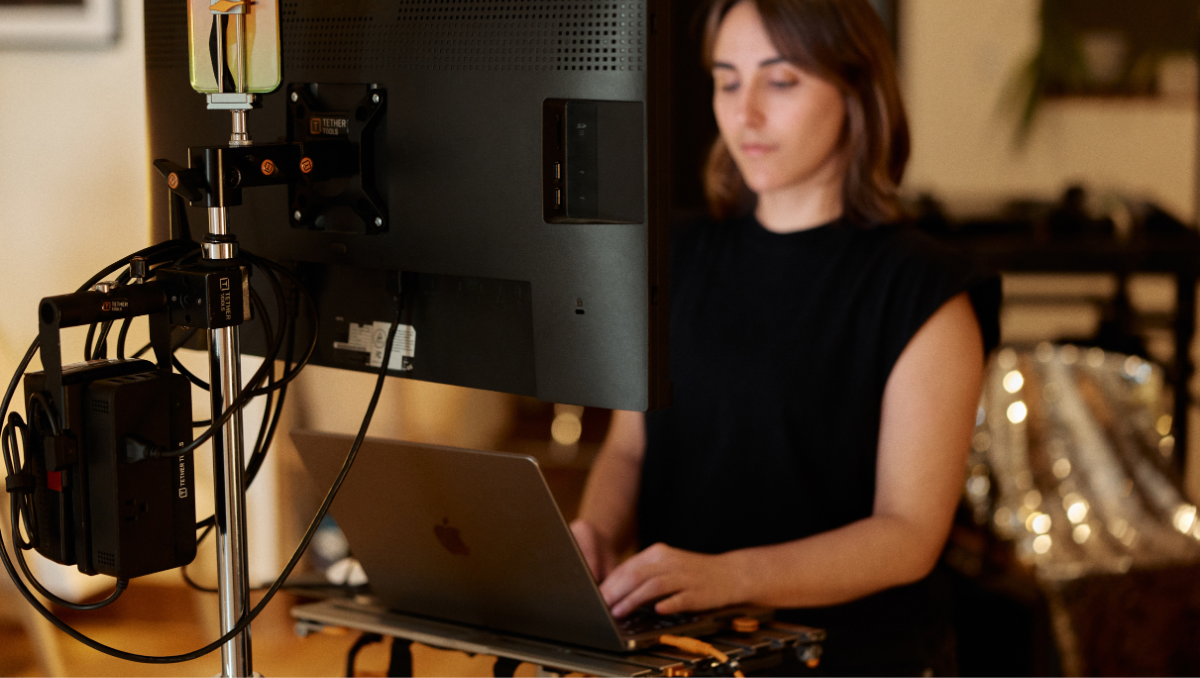
The phone mount also supported behind-the-scenes capture as part of the same setup.
“We really enjoy these new accessories. Really helpful for quick and portable shoots. The phone mount is perfect to help create content while shooting.”— Dariane Sanche (DS Sanchez), fashion photographer
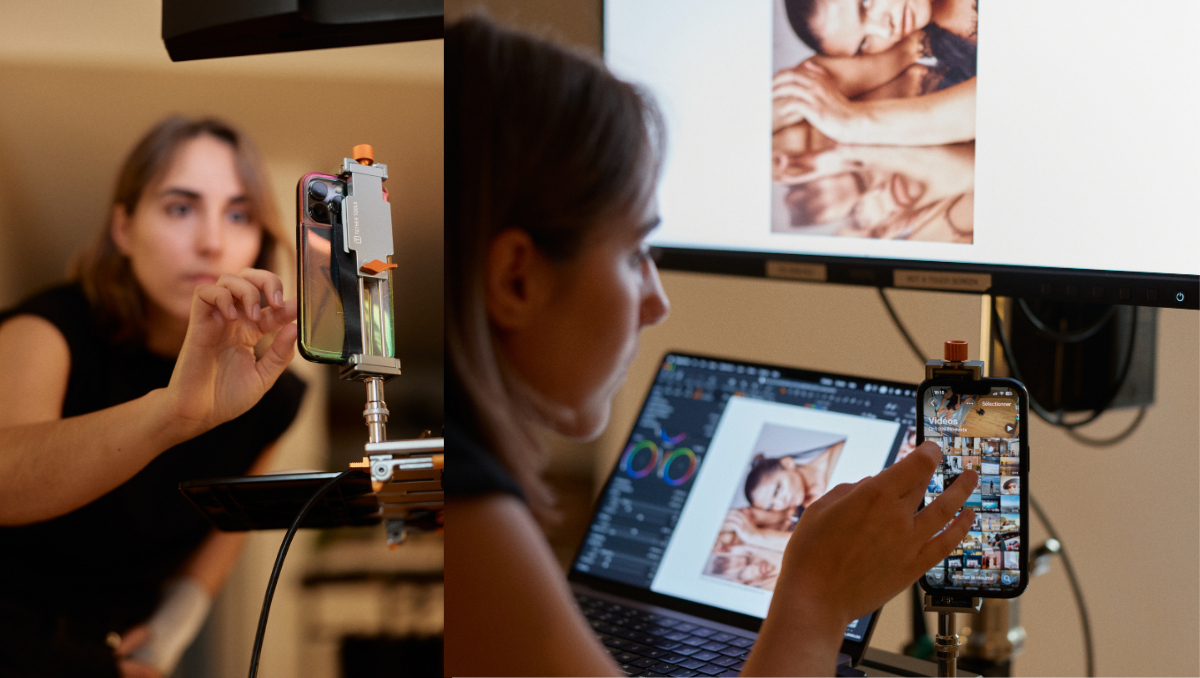
The workstation was not the idea behind the photographs. It was the infrastructure that helped the team protect the idea as the shoot moved from test frames to full-length fashion images and detailed beauty portraits.
The final takeaway: make every decision speak the same language
What makes Bodies as Architecture compelling is not one dramatic technique. It is the alignment of many quieter decisions.
The location supplies line and reflection. The posing converts the body into shape. The wardrobe creates weight and silhouette. The makeup adds repetition at the smallest scale. The diffused umbrella balances softness with definition. The edit moves between clean portraiture and graphic treatment without abandoning the central idea.
For photographers, that is the most useful lesson from Sanche’s set: begin with a visual sentence strong enough to guide the location, light, pose, crop, and final sequence. When every choice speaks the same language, the gear becomes what it should be—a means of keeping the creative process moving.
Build the AeroTrac setup used on this shoot
- AeroTrac Workstation Ultimate Tethering Kit — expanded studio configuration for the laptop, external monitor, and production accessories.
- AeroTrac Workstation Pro Kit — portable workstation configuration used on location.
- AeroTrac Tablet & Phone Mounting System — dedicated mounting for behind-the-scenes capture and other phone- or tablet-based production tasks.
Explore the AeroTrac Workstation System
About Dariane Sanche
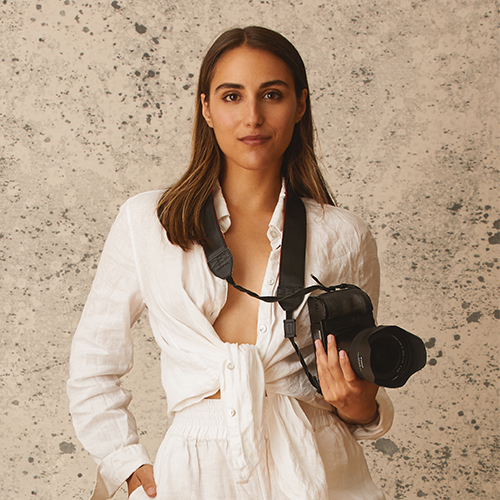
Born in Mont-Laurier in Quebec’s upper Laurentians, Dariane Sanche began learning Photoshop at age nine and bought her first camera at seventeen. She soon specialized in fashion and beauty photography, moving to Montreal at twenty to open her own studio.
Working internationally under the name DS Sanchez, she creates fashion, beauty, editorial, commercial, and advertising imagery marked by controlled light, tactile surfaces, strong silhouettes, and a cinematic atmosphere. Her work has led to collaborations with Tether Tools, Capture One, and Broncolor, along with recognition in Montreal’s fashion community.
Production credits
- Photographer: Dariane Sanche / DS Sanchez
- Light technician / digital technician: Marc-Antoine Gascon
- Makeup: La Petite Vengeance
- Model, styling, and hair: Gabrielle Cosentino
- Lighting: Broncolor Siros 800 L with 110 cm silver umbrella and diffuser
- Indoor lighting: Broncolor Scoro 3200 power pack with three Broncolor Pulso G heads; two 105 cm transparent umbrellas and one diffused 110 cm umbrella
- Camera and lenses: Canon EOS R5 Mark II; Canon RF 28–70mm F2 L USM and Canon RF 70–200mm
- Exposure: f/5.6 at 1/160 second indoors; f/5.6 at 1/250 second outdoors
- Tethered workstation: Tether Tools AeroTrac Workstation System Ultimate Tethering Kit with expanded AeroTrac accessories
-

TetherPro Optima 10G USB-C, Straight to Right Angle Cable
Price range: $19.99 through $159.99 Select options This product has multiple variants. The options may be chosen on the product page -

TetherGuard® LeverLock® Plus Plate
$99.99 Add to cart - $146 OFF
AeroTrac™ Workstation Ultimate Tethering Kit
$146 OFFOriginal price was: $1,145.89.$999.99Current price is: $999.99. Add to cart
